Friday, April 2, 2010

The Last Invisible Boy by Evan Kuhlman


Summary:

MY NAME IS FINN GARRETT AND THIS IS MY STORY.


I don't want to give anything away, so I'll tell you what you could probably guess from looking at the cover and flipping through the book.

1. It's about an invisible boy. Obviously. That's me. Actually, I'm not totally invisible. Yet. But I'm getting there.

2. There are a bunch of my drawings.

3. There are some really funny, really happy moments.

4. Just so you know, there are also some sad moments.

5. Everything in here is the truth. So if you like stories about true things, you might like this book.

That's all I'm going to tell you. All the stuff about my dad and my mom and my brother Derek and my friend Meli and whether or not I actually turn invisible or become completely visible again or figure out how to use my invisibility for the good of all mankind or just disappear altogether, you're going to have to read to find out.

So, let's get started. Just remember: This is my story, and anything can happen.


The Last Invisible Boy
is one those books that actually made me "bust a feeling" as my friends and I would say. The touching work of fiction is told by 12-year old Finn Garrett who tells his story through this book...his book. Finn believes he is turning invisible and decides to write this book in order to share his thoughts. After a short introduction he tells the reader that his is "a story about losing something. No, it's a story about sudden change." Soon after we find out that he somehow lost his father. Finn's "invisibility" has to do with the fact that soon after the loss of his father his skin has grown extremely pale and his once black hair has slowly turned white leaving him looking ghostly. Finn believes that soon he'll disappear. Finn's story reads like a diary (think Diary of a Wimpy Kid) and is written in such a way using words and pictures. Evan Kuhlman uses the voice of Finn to tell wonderful and sad stories through Finn's young eyes. Finn questions the reasons why he's turning invisible as he struggles with keeping it together for his emotionally-wrecked mother and younger brother. The story is so touching because as a reader I realize that Finn knows his condition has to do with the death of his father, but Finn doesn't want to talk about what he calls "The Terrible Day that Changed Everything." The book deals with Finn's emotions through how he deals with everyday life. Through his words he unknowingly showed me denial, betrayal, grief, acceptance, and growth.

What I found really cool about this book is that Finn constantly questions the reader to think about things that might be a bit "deep" but he also understands that if it gets to deep you can always take a time out. Another cool thing he does throughout the book is to question what the names of the people he knows and meets mean. Finn means "fair hero."

When Finn finally comes to an understanding of how his father's death is directly related to his invisibility it is a moment that makes it clear that kids can process heavy emotions and situations even though it may be hard. Wow.

I think this is a great book for kids 8 and older...and by older I mean adults too!

Oh and by the way my name means "Healer"...what does yours mean?

Author Website:

http://www.evankuhlman.com/

How to Eat Fried Worms...Book versus Movie

I came across How to Eat Fried Worms by Thomas Rockwell while shelving books the other day. It brought back such great memories of all the old-school books I used to read. I told myself that I should read it again, but made up a million excuses as to why I couldn't. A few days later I was shelving movies and came across a movie version of the book. "Oh boy, another movie version of a beloved children's book," I thought to myself. "These are hit or miss. Usually miss." I didn't even realize a movie was made of How to Eat Fried Worms. 2006 to be exact. I remembered what I had told myself a few days earlier so with movie in hand I grabbed the book off the shelf. I just had to re-read the book and compare it to the movie...so here it goes.

__________________________________________________________________

Summary of the book:

By way of bet, Billy gets into the uncomfortable position of having to eat fifteen worms. The worms are readily supplied by his opponent, and Billy has a free choice of condiments, from peanut butter to horseradish. With his wavering courage bolstered by the moral support of his friends and family, Billy munches away courageously. But there is many a slip twixt the worm and the lip, and the outcome of the bet is continually in doubt.


Summary of the movie:

The new kid at school faces up to the school bully by taking on a challenge no one has the guts to try in this family-oriented comedy. Billy (Luke Benward) is an 11-year-old boy whose folks have just moved to a new town and is facing the terror of his first day at a new school. It doesn't take long for Billy to run afoul of Joe (Adam Hicks), the school bully, who finds the live bait Billy brought with him and throws it in his face, asking Billy if he eats worms for lunch. Billy tries to gross out Joe by saying yes, he eats worms on a regular basis, and Joe calls his bluff by challenging him to eat ten worms in front of the student body. Billy takes the bet, and suddenly becomes something of a celebrity at school as the first kid to stand up to Joe. Billy also discovers he's caught the eye of Erika (Hallie Kate Eisenberg), a cute girl in his class, but can he actually eat the worms without losing his lunch? With the help of a handful of new friends, Billy preps for the big contest by learning how to eat as much gross stuff as he can, and he gains an unexpected ally in hot-headed Principal Burdock (James Rebhorn). Based on the popular children's book by Thomas Rockwell, How to Eat Fried Worms also features Tom Cavanagh, Kimberly Williams-Paisley, and Clint Howard. ~ Mark Deming, All Movie Guide

The book, How to Eat Fried Worms, is an quick and easy to read classic. I think kids as young as 7 or 8 would like this story of four boys hanging out in the country during summer and one of the boys, Billy, finds himself at the tail end of a bet between his friends. The bet requires him to eat fifteen worms in fifteen days. The storyline is simple yet the characters come alive in situations like how to prepare the worms so they don't taste horrible. Sometimes the creations seem grosser than the actual worm. I really think young boys would appreciate the gross out humor of the story. The story also touches on the brief falling out the boys have over the competitive nature of the bet. There is cheating, fighting, and a few dangerous situations that Billy and his friends must deal with throughout the story. Reading it again after probably over 25 years brought back so many memories. The book still holds up today as one of the best books for kids!

The movie is a whole other story. I don't even know where to begin without sounding like I totally hated the movie but....I totally hated the movie. Hollywood stuck its claws into the laid-back, summertime in the country feeling of the book and tore it apart. It was put back together somewhere in the suburbs with a bunch of wacky and crazy child actor kids. The movie kept the names of the original four boys from the book. Movie Billy is the new kid in at school. He also has a weak stomach as we learn from the opening montage which involves his father pulling the car over every few miles so Billy can throw up. It's not made much better by Billy's little brother sloppily devouring a bean burrito in the back seat. Gross out factor. Check.

The movie had too many differences from the book to count which is why I probably disliked it so much. Let's just say their were more characters, a love interest, 10 worms instead of 15, and a ring that a bully wore that was rumoured to cause sudden death. Ugh. The only similarity I really saw was the fact Billy had to eat worms because of a bet. The director and producers of this movie really took the term "based on the book" to a whole different level.

One good thing I can say is that the movie would probably be enjoyable if I didn't love the book so much and that would be if I was watching it with my 6 year old nephew.

Reviews and such:
http://www.commonsensemedia.org/book-reviews/how-eat-fried-worms

http://www.rottentomatoes.com/m/how_to_eat_fried_worms/

Puberty! It doesn't have to be so scary and confusing.

Puberty for me was a whirlwind of confusing changes to my body and roller coaster emotions which I can recall in vivid detail. I know that we learned about it in 6th grade health, but it seemed that those of us who hadn't gone through it yet were so busy laughing or being nonchalant that we didn't soak up any information for future use. Those that were going through puberty listened with open ears and blushing faces. Those that were further along the puberty path with their deep voices, hairy legs, and what seemed like giant proportions; those were the ones that had a certain pride and air of knowledge. Of course, I'm talking about the boys here. Girls were a whole other confusing subject.

I don't recall my parents ever talking to me about any of the changes I was going through. I went head first into puberty and searched out the answers in my health books. Back then we had no Internet or materials in the library like kids do today and the thought of asking my parents filled me with shame and embarrassment. I vaguely recall covering puberty in health class but then again I probably immediately shut out the voice of the teacher when she said the word "penis"...ewww (insert giggles).

While performing my page duties at my neighborhood library I noticed that the four books in my hand had similar call numbers. They were all 613 give or take a few decimal points. They were all books for boys about puberty. I chuckled to myself and at the same time felt a kinship with the young mystery patron who had recently returned the stack of books...most likely to the book drop while no one was looking. I thought it would be fun and interesting to read one of the books just to see how well it covered the subject of puberty for boys and while I was at it I found a similar book just for girls and decided to read that too. Here's what I checked out.

____________________________________________________________________

The "What's Happening to My Body?" Book for Boys by Lynda Madaras with Area Madaras


Martin Anderson, M.D., M.P.H. states in the foreword to this book that it "functions equally well as an owner's manual for teens and as a teaching guide for their parents." I totally agree with the doctor. The author, Lynda Madaras, suggests that parents and teens/preteens should read it together. I only partly agree with the author. I am torn when it comes to Madaras suggestion if only for the fact that puberty can be embarrassing for not only boys but for their parents too so reading it together may not be as productive as reading it separately and then coming together to talk about it. But then again every situation is going to be different. I know that if this book was available to me 25 years ago I probably would have read it alone and figured it out by myself. I would have been way too embarrassed to talk about these things with my parents and they definitely told me nothing about puberty. I went into it pretty blindly. This book covers a lot of information that is definitely valuable for all boys to know when going through puberty. Here is a list of the chapters and followed by some of the topics each chapter covers.

1. Puberty
Sex, Male/Female Sex Organs, Sexual Intercourse, Making Babies

2. Beginning Changes and The Stages of Puberty
Starting Early/ Starting Late, Developing Quickly/ Developing Slowly, First Changes, The Stages of Puberty, Feelings About Puberty, Am I Normal

3. An Owner's Guide to the Sex Organs: What's Normal? What's Not?
Penis Size, The Penis: Circumcised and Uncircumcised, Other Variations in the Penis, The Scrotum

4. The Puberty Growth Spurt
The Height Spurt, The Weight Spurt, Your Changing Shape, The Strength Spurt, Taking Care of Your Body, Feeling Good About Your Body

5. Pimples, Perspiration, Body Hair, Shaving, and Other Changes
Underarm and Body Hair, Facial Hair, Perspiration and Body Odor, Pimples and Acne, Voice Changes, Breast Changes

6. Changes in the Male Reproductive Organs: Erections, Sperm, and Ejaculations
Erections, The Male Reproductive Organs, Ejaculation, Health Issues

7. Spontaneous Erections, Orgasms, Masturbation, and Wet Dreams

8. Girls and Puberty

Similarities and Differences, The First Changes, Stages of Puberty, Sex Organs, Menstruation

9. Romantic and Sexual Feelings

"Just Friends", Crushes, Homosexual Feelings, Dating, Falling in Love, Making Decisions About How to Handle Your Romantic and Sexual Feelings, Sexuality: Feeling Private/ Feeling Guilty, Sexual Crimes

___________________________________________________________________
Girl Stuff: A Survival Guide to Growing Up by Margaret Blackstone and Elissa Haden Guest


The authors open up this book by saying there are certain words that made them cringe when they were kids: menstruation, pimples, sanitary napkin, puberty, adolescent, "that time of the month", staining, and "how are you feeling?". As a person belonging to the male gender I can say that I can relate to a few of these cringe-worthy words, but I can't lie and say that I don't know what the other ones mean and if there was any confusion I definitely know what they mean after reading this very well written and informative book with it's fun sidebars and illustrations. Chapters and topics include:

1. What's Going On on the Outside
Hormones and glands, the outside for boys and girls, breasts, bras, body hair, body odor, eating disorders, healthy eating

2. The Zen of Acne
Causes, skin types, skin care

3. What's Going On on the Inside
Your amazing body, reproductive organs, menstruation, tampons and pads

4. What's Going on With Your Emotions
New things to worry about, How puberty affects friendships, What makes a good friend?, What makes the cool kids "cool"?, Coping with puberty, alternative medicine

5. Peer Pressure: The Good, the Silent, the Bad, and the Dangerous

6. Protecting Yourself
Trusting your instincts, How to be safe but not fearful

7. What You Never Wanted Anyone to Know You Want to Know About Sex
The prelude to sex, How does a woman become pregnant?, Making love, Waiting till you're older, Who are you attracted to?, If I have a crush on a girl am I gay?, STDs, Birth control

8. Many Rivers to Cross

Both books in my review conclude with a variety of important resources for tweens/teens if they have further questions, or want to get involved with specific organizations. Also included are books for further reading.

Again, I think its wonderful that kids have access to these kind of books! It sure would have helped me out a lot as a kid.

Tuesday, March 30, 2010

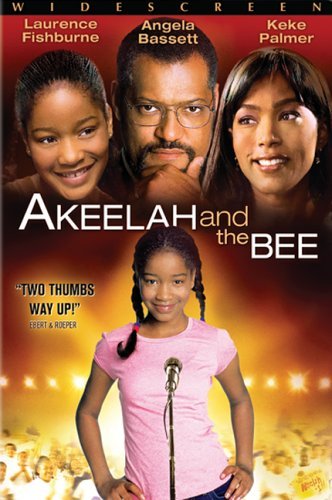
Akeelah and the Bee

Summary:
An inspirational drama, Akeelah and the Bee is the story of Akeelah Anderson (Keke Palmer), a precocious eleven-year-old girl from south Los Angeles with a gift for words. Despite the objections of her mother Tanya (Angela Bassett), Akeelah enters various spelling contests, for which she is tutored by the forthright Dr. Larabee (Laurence Fishburne); her principal Mr. Welch (Curtis Armstrong) and the proud residents of her neighborhood. Akeelah’s aptitude earns her an opportunity to compete for a spot in the Scripps National Spelling Bee and in turn unites her neighborhood who witness the courage and inspiration of one amazing little girl.

I have to admit that I've avoided watching this movie since it was released in 2006. I have no idea why. I think it was just one of those movies that I said I'd get to eventually. The title has popped up in my life so many times that I finally picked it off the shelf at my library and decided to give it a go. Honestly, I knew nothing about the movie except it seemed that a lot of kids liked it. I thought it was about a cute African American girl and a bee...as in bumblebee so I was pleasantly surprised when I found out it was about spelling!

At the start of the movie Akeelah is walking through the her south Los Angeles neighborhood with her best friend. In a voice-over she asks, "You know that feeling where no matter what you do or where you go you just don't fit in? 'Cause that's how I feel all the time." Even for kids, or adults who don't have an answer to her question, most of us know what it's like to not fit in and I wanted to know why Akeelah felt this way, so I settled in for what ended up being a very enjoyable movie.

11 year-old Akeelah attends a school known for low test grades and being one of the poorest schools in her area. The students are just trying to get through each day and that includes Akeelah who doesn't want to stand out yet has a love for words and language which she learned from her father who we find out passed away when Akeelah was only six. Akeelah spends her time playing Scrabble online and reading the dictionary while at the same time skipping class and doing poorly in school. The school principal threatens Akeelah with detention, but because of a teacher that notices Akeelah's gift for words and language, she is given the opportunity to avoid detention by entering the school's spelling bee. Enter Dr. Larabee, a professor and former national spelling bee contestant, who witnesses Akeelah as she breezes through the school competition. Dr. Larabee agrees to coach the hard headed and feisty Akeelah in order to help her reach the nationals. In the process he also becomes a father figure.

Akeelah's journey to the nationals puts her through some tough situations: peer pressure, lack of support from her overworked mother, jealousy from her peers and friends, insecurities about not being worthy and good enough. Although these can be overwhelming subjects to deal with, the movie does it in a way that kids of all ages can relate. When Akeelah enters the first spelling bee we see the two female school bullies making fun of her with giggles and taunts. The scene keeps the focus on Akeelah, but the quick moments with the bullies immediately had me rooting for Akeelah to win. Another well shot scene is when Akeelah makes friends with other contestants in the spelling bee. Most of the kids are from well-off families. What's interesting is the director chose to include kids from a variety of cultural and ethnic backgrounds. When Akeelah attends a birthday party for one of her spelling bee friends she brings her best friend from school. Her friend decides to not go into the party with Akeelah. Akeelah doesn't quite understand why, but the audience watching the film knows that her friend feels out of place around the "smart" and "rich" kids. What makes this film really worth watching is its message that kids can overcome the obstacles in their lives regardless of where they come from. Akeelah has to decide what is important to her and it is great watching her go through her journey to the national spelling bee championship. A great uplifting movie for young and old alike!

Tuesday, March 9, 2010

A Shout Out From James Preller!

I was so excited to see a comment on my blog from James Preller, author of the "Jigsaw Jones" mystery series and the recent, "Bystander". I reviewed "Bystander" earlier in my blog and he responded to it and gave me a shout out on his blog! Wow....I am being constantly reminded everyday, in little and big ways, of why I want to be a librarian and a writer and an artist and a kid....

Here's what he had to say:

"...* Here’s a cool new blog, titled Future Librarian, Kids! He’s just up and running, and I remember those early months of trying to figure it out, so hop on over and say hello. He’s posted some well-written reviews and also took the time to remember School House Rocks — and you’ve got to love that in a blogger. In a review that was obviously written with great care, the unnamed “future librarian” writes: “The theme of keeping silent over speaking up runs deep throughout the book . . . Needless to say, I read Bystander fairly quickly and really enjoyed it. It captures the feeling of middle school quite well and I really felt compassion and understanding for all the characters.”"

http://www.jamespreller.com/

Tuesday, March 2, 2010

So Hard to Say by Alex Sanchez

Summary:

Frederick is the shy new boy and Xio is the bubbly chica who lends him a pen on the first day of class.

They become fast friends-but when Xio decides she wants to be more than friends, Frederick isn't so sure. He loves hanging out with Xio and her crew, but he doesn't like her that way.

Instead, he finds himself thinking more and more about Victor, the captain of the soccer team. Does that mean Frederick's gay? He can't be-he sees how everyone makes fun of Iggy, a boy all the other kids think is gay. Frederick has to deal with some tough choices: Even though he is curious about Iggy, he's just started fitting in at his new school, and he doesn't want to lose Xio, his best friend.

In So Hard to Say, Alex Sanchez, acclaimed author of the groundbreaking novels Rainbow High and Rainbow Boys, of which School Library Journal said, "It can open eyes and change lives," helps younger readers look at self-discovery, coming to terms with being gay, and acceptance of people who are different from us. He says, "The book comes in response to so many teachers, librarians, and students asking for a story like this."
I was a big fan of Sanchez's YA novels Rainbow High and Rainbow Boys so I chose So Hard to Say because I was curious to see how he wrote about gays issues from a tweens point of view. A tweens struggle with coming out of the closet can be one of the most difficult events in his or her life because its usually a time when hormones are racing, voices are changing, and wanting to be accepted among your peers is top priority. Not only is it a struggle for the gay tween, but the other tweens who must learn to form opinions and views about homosexuality. Is it right or is it wrong? Is it more important to fit in with the popular vote and continue to use terms like "that's gay" or "faggot" or is it more important to stand up to homophobia at the risk of being shunned? So Hard to Say tackles these issues through the voices of Frederick, the shy new boy at school and Xio, the sassy popular girl in love with him. It's a simple story with each chapter alternating from Frederick's voice to Xio's. Frederick tries to figure out why he doesn't feel the same way about Xio as she does for him. He feels those ways about Victor, the captain of the soccer team. Frederick finally begins to come to terms with being gay via the picked-on gay kid at school, Victor. The revelation forces everyone involved to deal with what it means to be gay and to have friends who are guy. In the end some of the kids make the right decision yet some choose to follow the crowd.

I love a well-written book that is a positive resource for kids struggling with sexuality and this book is definitely one of them. Another great one from Mr. Sanchez! I wish I had authors like this around when I was growing up!

About the author:

http://www.alexsanchez.com/Teen%20Reads.asp.html

More on the book:

http://www.alexsanchez.com/So_Hard_To_Say/So_Hard_To_Say_Excerpt.htm

http://books.simonandschuster.com/So-Hard-To-Say/Alex-Sanchez/9780689865640

OMG! I am so on this one!!! Golden ticket here I come!

This post is not a review. I just had to share my excitement. I wish I could get all Veruca Salt with this Willy Wonka promotion...but I don't have the spoiled luxury of having a rich dad so I'll probably be relying on luck just like Charlie.


Here's a bit of info I found about the contest

http://www.slashfood.com/2010/03/01/willy-wonkas-golden-ticket/